In the aftermath of the Bondi attack, Australians respond in a way that reveals something profound about our national identity.
Bondi Beach, Sydney, Australia.
It was the vision that gripped the world
A passer-by tackles one of the Bondi shooters, wrestles him to the ground, and grabs his gun.
In a moment of extraordinary bravery, that man put his life on the line to save strangers. He took multiple bullets from the second gunman for his troubles.
Then we learnt the hero’s name.
Ahmed al Ahmed. The Aussie hero of the day came here as a Syrian migrant ten years ago. He is a Muslim man who risked his life to save Jewish strangers.
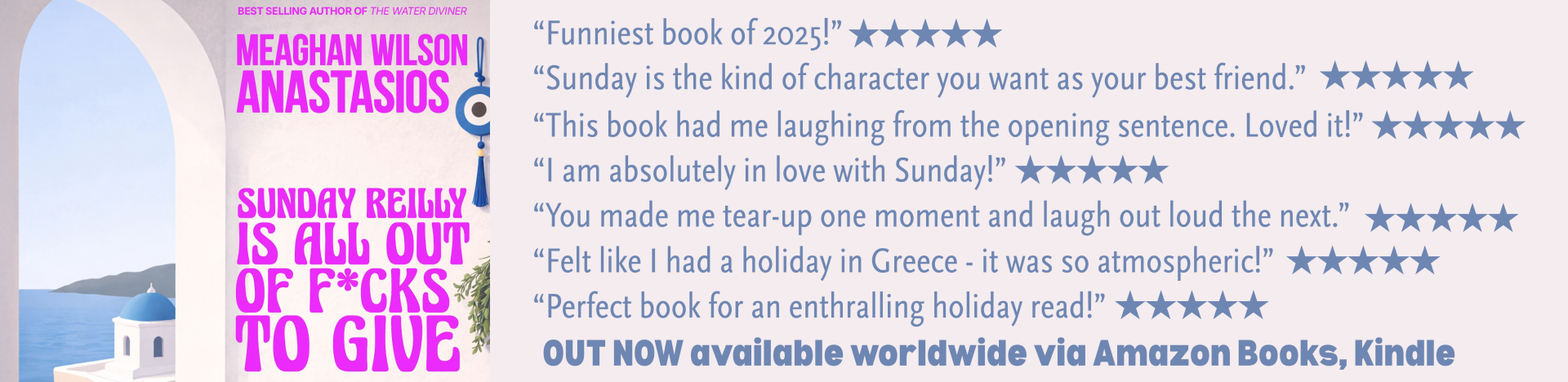
Yeah. Me too. It’s why I wrote ‘Sunday Riley is all out of f*cks to give.’
Marrakech’s medina broke me.
Koutoubia minaret, Marrakech, Morocco. Photo by M. Wilson Anastasios
That was where my latest novel, Sunday Riley is all out of f*cks to give, began.
It was meant to be the trip of a lifetime.
A three-month working holiday for me and the husband. A ‘grown-up gap year,’ was how we put it. With our second child graduated from high school, last year we decided to escape Melbourne’s bitterly cold winter in favour of summer in our beloved Mediterranean.
One month in the tiny, hilltop Andalusian village of Gaucín; another on the Sicilian island of Ortigia; and the third on the tiny Greek island of Symi, with side-trips to Morocco, Puglia, and Turkey.
Sounds pretty fucking brilliant, right? Yeah. It was never going to be that easy, though.
The art of storytelling and why it’s not going to die anytime soon
Once upon a time, there was a moment in human history when one of our ancient ancestors looked down at her or his hand and thought, “What the fuck am I? Where did I come from? What am I doing here? And, wow, check out this opposable thumb!”
There’s a good reason we respond to stories. Human beings have been storytellers for as long as we have been capable of abstract thought.
Stories have always been more than just entertainment.
At its most heightened, storytelling is a way of grappling with the vast and abstract nature of existence.
Stories are how we capture, condense, and communicate the essence of what it means to be human.
At its most basic, storytelling is about survival. Tales of gods and heroes make sense of natural forces outside our control. Myths and legends are mnemonic devices that allowed us to survive and thrive as a species.
Press freedom, journalists holding power to account, and why it matters now more than ever.
When the world’s biggest oinker called seasoned White House correspondent, Catherine Lucey, “piggy,” the world was horrified.
Of the many stains on the soiled toilet-paper roll of horrors Donald Trump has delivered, I don’t know why this one upsets me so much. But it does. And I know I’m not alone.
It’s the abnormally stubby little finger stabbing the air. It’s the physical aggression from a bloated bucket of lard, and the tone of voice familiar to anyone who’s ever been in an abusive relationship. It’s the born-to-rule air… the unwavering sense of entitlement. The certainty that he can do whatever the fuck he wants without ever being called to account.
It’s the fact that he does it while demeaning a woman representing an institution that exists to protect every one of us.
There’s been a bit of a thing online lately where people are questioning the point of creative work, now that AI is replacing so many skilled craftspeople in the creative industries.
Fuck that.
If you’ll happily surrender your creative outlet because a machine can have a fair stab at whatever it is that you do, then you don’t have a creative bone in your body.
Creative expression is an addiction. You may as well tell a junkie to go cold turkey.
Creativity is not a job. It’s a calling. A primal urge. There’s no turning it off.
Will I stop writing novels now that ChatGPT can spit one out in thirty seconds? Not on your life.
Does it mean that my work will be lost in the tsunami of AI-written material that’s flooding the airwaves and drowning out real, human voices?
Taking the spark of an idea and turning it into something totally new, simply for the joy of creating something, is the one thing that distinguishes us from all other creatures.
That’s not to say that animals don’t create remarkably beautiful things. Whales sing to one another from one side of the vast Pacific Ocean to the other. Male bowerbirds scour the undergrowth for iridescent blue trinkets to adorn their elaborate grass bowers. Even the humble toadfish creates mandala-like designs with their fins on the seafloor. But they do those things with a greater purpose; in most instances, to attract, or keep, a mate.
Because, of course they do. The things creatures will do for a date, right?
But human beings make things just for the sake of making them. It’s not about convenience or function. We do it just because.
Just because you can buy a pre-fab iced cake at Coles, if you love baking, do you go for that rather than making one yourself? Hell, no.
Sure, you can order a Richmond scarf online from Tigerland (shut up, haters). Does that mean you don’t have a go at whipping one up for the season opener if you’re a halfway decent knitter? Forget it.
Creativity will never die, because it comes as naturally to humans as breathing.
But can the creative industries survive the AI-generated assault it’s currently enduring? Well, that’s another question altogether.
I would genuinely like to know why the first industry the tech bros locked in their sights was the creative one. Why not direct their efforts towards curing cancer? Or solving the climate crisis? Perhaps because to them, true creativity is a puzzle to be solved.
We creatives were all a little too smug when AI first appeared on the scene, weren’t we? “Oh, they’ll never be able to replace us!” we all cried. “It’s just a tool! We can have fun with it, right?”
It wasn’t just that my own work was being used to create a system whose primary aim is to make jobbing writers like me redundant. Though that is certainly a thing. It was because as any creative writer will tell you, our work means a great deal more to us than just words on a page.
Our souls are sandwiched between the covers of our books.
When I write something for pay — a piece of copy for a developer, a script for a documentary series, a pitch document for a feature film — it’s an exercise that primarily comes from my head. There’s a series of switches I’m conscious of flicking on and off to tap into a particular voice, tone, and lexicon to suit a specific job.
Unless you’re J.K. Rowling, you’re not raking it in as a novelist. It’s a labour of love. We take on all the risk. We work for years without pay and with no expectation that whatever it is that we’re writing will even end up being published. Speaking for myself, I have two full manuscripts on my laptop that most likely will never see light of day.
Yes, we all want to find an audience and are incredibly grateful when we do, no matter its size. But the returns are so microscopic, there’s no expectation that sales and royalties will ever pay the bills.
And there’s the rub. The jobs that have been subsidising my creative work are drying up because the work of many thousands of writers like me has been plugged into a system that is designed to stop us earning a crust. In the past twelve months, what was a flood of work that had been keeping me liquid for more than ten years has dried to barely a trickle.
I’ve heard plenty of people put forward the argument that it’s no different from the very many times in human history that technology has sent industries packing.
No doubt Thomas the Tank Engine’s stoker was pretty pissed when the diesel train first appeared on the horizon. If he was of a certain age, he would have taken a package and, well, quite possibly taken up a creative pastime in his retirement that had nothing to do with his profession. If he was younger, he would have re-skilled and moved into a new industry.
But the thing with creative work is that the more you do it, the better you get at it. The wedding singer might prefer to poke her eardrums out with knitting needles than sing “Horses” at yet another suburban wedding. But every time she does, she’s improving her voice, and her stage performance. And that feeds into the gigs she does in front of three people at a bar in Northcote. One day, it may be the foundation of what will be a long, and brilliant, career as a singer.
It’s the same for me. Writing-on-demand has been my apprenticeship. Every pitch I write for a drama series. Every description of an apartment complex I write for a website. Every script I write for a documentary. Every article I’ve written. They’re made to order. They must fit a brief. My creative skills are on a leash. But every job has made me the writer I am today. They have made me faster, more efficient, and more confident.
What of the emerging creatives whose only engagement with the nuts and bolts of the industry will be crafting careful prompts for AI to spit out something they once would have made themselves? What will that mean for them as they try to find their own voice?
We’re born with the urge to create. Anyone who’s seen a baby spreading its mushed carrot over its dinner tray can tell you that.
It comes down to the gesture. Our ability to make a mark.
That urge, I’m sure, comes from our sense of mortality. It’s our way of leaving something behind; something that bears witness to our passing through this world.
When I was a small human, and an agnostic one at that, I decided that the Old Testament tale of the Garden of Eden was a story about the evolution of human consciousness. Yes, I was a peculiar child.
To me, it was about the loss of innocence when our early hominid ancestors decided that hanging about in the jungle eating roots and leaves was boring as fuck, what with all that vast savannah out there. Then came the opposable thumb, and we were — quite literally — off and running.
That was the getting of wisdom. But it came at a cost. Because we quickly became aware of our impotence in the face of natural forces, and our mortality. Magic, ritual, and religion are how we try to deal with the former. Creativity — the making of marks and leaving behind testaments — is how we try to cope with the latter.
The main reason we’ve thrived? The fact that we band together and look after each other. We’ve been able to develop complex and large brains because our mums carry us around for a ridiculous amount of time. They also give us high-energy breastmilk that go towards brain growth rather than limbs that would otherwise have us running around minutes after we’re born, which is normal for most mammals.
The other thing our hominid ancestors got from being carted around by their mothers for so long? Communication skills. Up-close facial expressions and sounds. The first humans developed complex communication because they were physically and emotionally bound to their mothers.
Communication and connection are key to human existence. It’s why social media has thrived. It taps into an evolutionary trait that’s been essential to our survival as a species.
We want to fight mortality and prove we were here.
But we also need to touch other people and hold them close. Whether that’s through words on a page, images on a screen, or a jumper knitted for a grandchild.
We want to make things that touch other people, because that connection is what holds us together.
It’s the thing that makes us, well… us.
We must fight to keep that instinct healthy and strong.
Without it, we are only skin-bags stuffed with blood, bone and meat.
But to the powerbrokers who worship at the temple of Mammon that is 21st century capitalism, what Mamdani is proposing is the thin end of what they see as a very evil wedge.
Because as First Lady Betty Ford said back in her time: “if the West Wing is the mind of the nation, then the East Wing is the heart.”
Reuters via Brian Rittmeyer on X
As the East Wing of the People’s House is smashed into bite-sized, (possibly) asbestos-ridden chunks while Trump’s supersize-me American flags flap away in the background, it feels like the beginning — or end — of something significant.
Stephen Colbert puts into words what most of America and the rest of the world feel. The carcass of what was until last week the First Ladies’ wing and grand public entrance to the White House looks like “a rotisserie chicken your dog got into.”
It’s more than just wanton destruction and vandalism.
OK, I’m going to say it. Plugging some prompts into ChatGPT and calling yourself a writer is like putting a frozen TV dinner into the microwave, pushing some buttons, and calling yourself a chef.
Generative AI is a compiler of information, albeit a creative and brilliant one.
It is the most accomplished plagiarist of all time. It can do a decent job of synthesising all the things ever written about standing on a beach and watching the sun set. But it will never know what the sand feels like between its toes. Or feel goosebumps on its arms as the night chill settles in the air and the breeze tickles at the waves. Much less know the sensation of supernatural awe we feel in the face of natural beauty.
AI is senseless, in the true meaning of the word.
It does not see. It does not hear. It does not smell. It does not taste. And no matter how convincingly it communicates with you, it does not feel. It is, remember, “Artificial Intelligence.” Not “Artificial Emotions” or “Artificial Sensations.” When AI describes something, it’s cobbling together things written by human beings.
The Turing test wasn’t a measure of real intelligence. It was about crossing a point where technology could convince a human being that it was human. But being “convincing” doesn’t make something “real”. Just ask any half-decent fairground magician.
As far as I can see, generative AI is kitted up in a very convincing cow-suit and is doing a pretty damned good job of mooing. But if you’re using that cow to get your milk, you’re going to be tugging at those teats for a very long time. And if anything comes out, it sure as fuck won’t taste too good on your breakfast cereal.
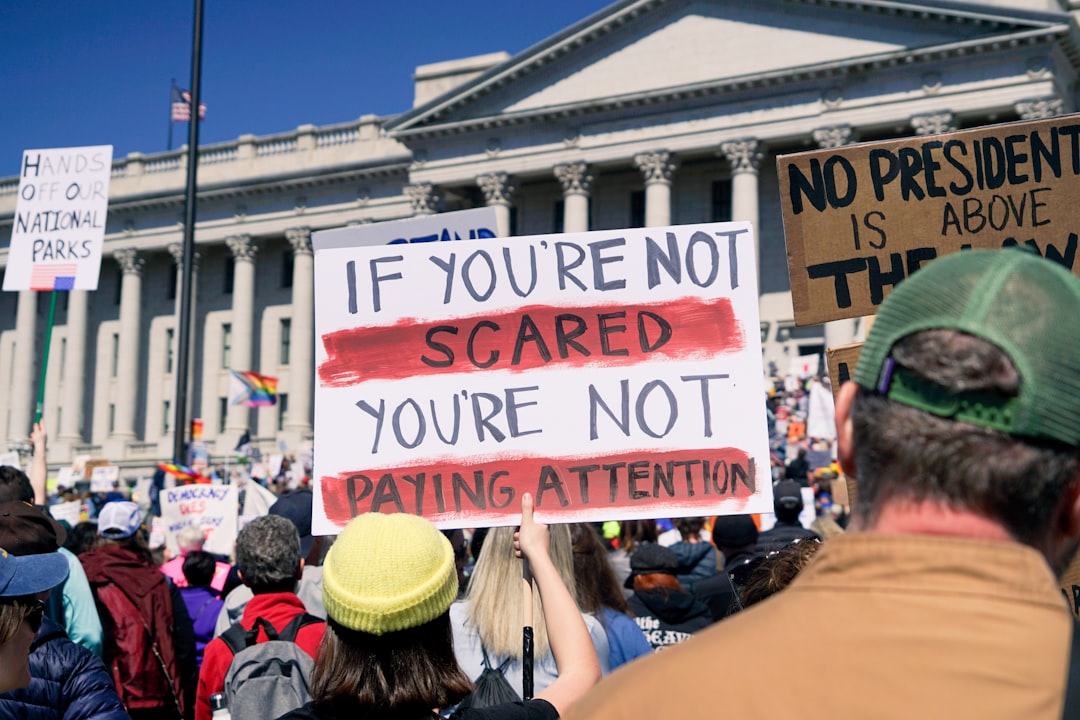
Resistance on that scale sends a message to America’s leadership, and to its allies around the world. It also strengthens the will of Americans who oppose what’s going on because they see power in numbers and realise they’re not alone.
Because behind the scenes, the system that supports American democracy is being devoured from within.
The destruction of the East Wing of the White House – the People’s House – is a ghastly metaphor for what’s being done to American democracy right now.
Whatever’s left will walk like a democracy. It will talk like a democracy. But it will be a shell of its former self.
Three things have crossed my desk over the past week that have made me think about the future and the world we’re making for ourselves. They also got me thinking about the number one way we can future proof ourselves and our way of life as a tsunami of technological breakthroughs led by mind-blowing advances in AI threatens to swamp us. If you’re interested, it’s also how I think businesses and individuals can stand out from the competition and survive the monumental changes headed our way.
So, what three things got me thinking? Number one was a hilariously woeful experience with an insurance company (read more about that here). Number two was an insight about AI shared by an economic visionary. And number three came from Mr Zeitgeist himself, Stefano Boscutti, a dear friend who is one of the few people who frequently manages to say things that make me think differently about something I thought I understood fairly well.
Nightmare before Christmas with Allianz Australia
I won’t bore you with a blow-by-blow account of the insurance debacle here – if you’re keen to know the details, it’s all outlined in my LinkedIn post. But, in short, Allianz Australia rejected my claim when my car was stolen, on the basis of a completely incorrect assumption on their part. No evidence. Just a stab in the dark. If you’re keen to read my tale of woe, have a read. And if you do, you’re not alone. The post went viral in a LinkedIn kind-of-way.
But, basically, my takeaway from the whole mess was that Allianz did not give two figs about me, or about the business I had given them for many years. I’m just another small chunk of meat in the sausage factory that churns out dividends for the company’s investors and obscenely huge salary packages for their executives. The company didn’t care if it lost my business, because there are plenty more minnows out there in the sea to fill the teensy gap I’ll leave behind when I ditch them. Care factor? Less than zero.
Take away: Multinational businesses are killing us. And they couldn’t care less.
Knowledge economy? Dead and buried, thanks to AI.
Economic wunderkind, Raoul Pal, recently declared AI “the single greatest innovation of humanity ever.” His reasoning is that it’s the death knell for knowledge as currency. By that reckoning, the days are numbered for any occupation that relies on accumulated knowledge. So, doctors, lawyers, university lecturers? AI is coming for you.
From a bigger-picture perspective, there are many jobs out there which are woefully underpaid, yet people still do them – think teachers, nurses, emergency services, not to mention most creative occupations. The economic reasoning has always been that there’s a non-financial benefit to those jobs, so people are willing to do them for the “feel good” aspects of occupations that are seen as a “calling,” rather than just a nine-to-fiver we do for a paycheck.
And that’s because human beings are not always rational creatures. There’s an awful economic model of humankind called homo economicus. Unfortunately, it underpins western economic thinking. It assumes that people are always rational and self-interested, and that they make decisions to maximize their own economic well-being. Which is patented bullshit. Always rational? There aren’t enough laughing emojis for me right now.
But the idea that knowledge as currency is done and dusted is a compelling one. I’m speaking as someone who values knowledge above most things. “Jack of all trades, master of none” is the saying that best applies to me. So that doesn’t bode well for my prospects. Except I do see a future by looking to the full quote: “Jack of all trades, master of none, though oftentimes better than master of one.”
What that’s saying to me is that diversifying is key. And as capable as AI might be at digesting and synthesising vast quantities of information in a heartbeat, it’s only as good as the human beings training it and directing it. We can see unexpected and unusual patterns because we’re used to dealing with the chaos that underlies the apparent orderliness and predictability of nature.
So knowledge still has a future. But knowledge as an organic and adaptable creature. Not knowledge as captured in binary code.
AI is stuck in the past.
AI is a tool. And a damned good one, as far as I can see. But as Stef Boscutti said to me, AI can only exist in the past. Relying on it too much is like trying to drive down a freeway while only looking in the rear-view mirror. And he’s absolutely right.
Stef also said to me once that all large companies should have a resident philosopher on staff. He’s absolutely right on that account, as well. If multinationals had someone on call to encourage them to frame their policies around deep thinking rather than an ugly dash for cash, the world would be a much nicer place.
But back to his thoughts on AI. Generative AI, even at its best, can only cobble together conclusions or creations based on the recorded fragments of things that have already been done.
It might be able to predict the future on the basis of probability and what’s happened in the past, but it can’t dream of a future that exists outside the confines of the information fed into its processor. Random events… a cascade of completely unpredictable moments… which have often initiated the most monumental shifts in human history, are outside AI’s capacity to reason.
We’ll always need human beings to imagine the future.
How to future-proof? It’s the human touch.
The solution? It all comes down to the human touch. Fast food chains didn’t mean the end of fine dining. If anything, it elevated superior nosh, because it stood apart from styrofoam packaged, flaccid burgers and batter-sodden chunks of the nastiest chicken bits scraped off the abattoir floor. Fast food gave us convenience, affordability and speed. But that’s all. A trip to Maccas is hardly top of the list for most of us when we really want a special experience.
It doesn’t matter what field you’re in. If you want to survive what’s coming, lean into your humanity. I’m not talking craptastic advertising emphasising how very human-oriented you are. I’m talking meaningful engagement with the people you should be treating as your community. It’s not hard. Take a little hit in the hip pocket and buy loyalty for life. I mean, how much fucking money do you actually need?
And as for the threat to professions? Well, as I see it, human-facing service providers (by which I mean everyone from your doctor, to the man who makes your coffee at your favourite café) are more important than ever. I don’t want to be told I have a serious illness by a machine. And I don’t want to chat with a robot about the weekend’s footy scores.
But where so many human-facing businesses are falling short is that they’re binding their people up with so many regulations and hoops to jump through, their human employees are unable to make a real connection with their customers. At both ends of the food chain, we’re being expected to operate like robots. It’s tiresome, it’s de-humanising, and – as far as I can see – it’s not helping anyone.
Be the person who gives a shit.
So, it’s pretty easy.
Be the person who gives a shit.
Be the company that treats its customers – and its employees – like human beings.
Be the service provider who goes one step beyond KPIs, and sets aside box-ticking and by-the-book-ing.
Be the creative who deep-dives into your soul and makes art that comes from a place that AI will never understand.
Because no matter how good a mimic it is, AI will never feel joy or love, much less grief or pain.
Being human is our superpower. We just need to work out how to use it.